Ends 5pm on the fifth. Withdraw and you forfeit 0.25% of the price. Waivable by a s66W certificate. And agents do ask.
nsw.gov.au · checked 4 Aug 2026
And you probably know whether you are in it.
Six different situations, and underneath all six the same sentence.
You are not frightened of being cheated. You are frightened you would not be able to tell.
You will sell a house two or three times in your life. The person across your kitchen table did it last week, and the week before, and will again on Thursday.
They have run this exact conversation hundreds of times. They know which of your objections are real and which ones are nerves, because the last forty sellers said the same things in the same order. They know how long to leave a silence before you fill it with a lower number.
That is not a conspiracy. It is repetition, and repetition is the entire advantage. You are not going to out-prepare it in an afternoon, and you are not going to get a second attempt at it.
Here is what makes it different from every other expensive mistake you have ever made.
Every other one announces itself. The car turns out to be a lemon. The renovation runs over. The invoice arrives and you open it.
This one does not. You will go to settlement pleased. You will tell people it went well. And you will never learn what the number could have been, because there is no second version of your sale to compare it against and nobody is going to post you the difference.
Almost every seller I saw went to settlement happy. Including the ones who left money on the table.
And here is what you can do about it tonight
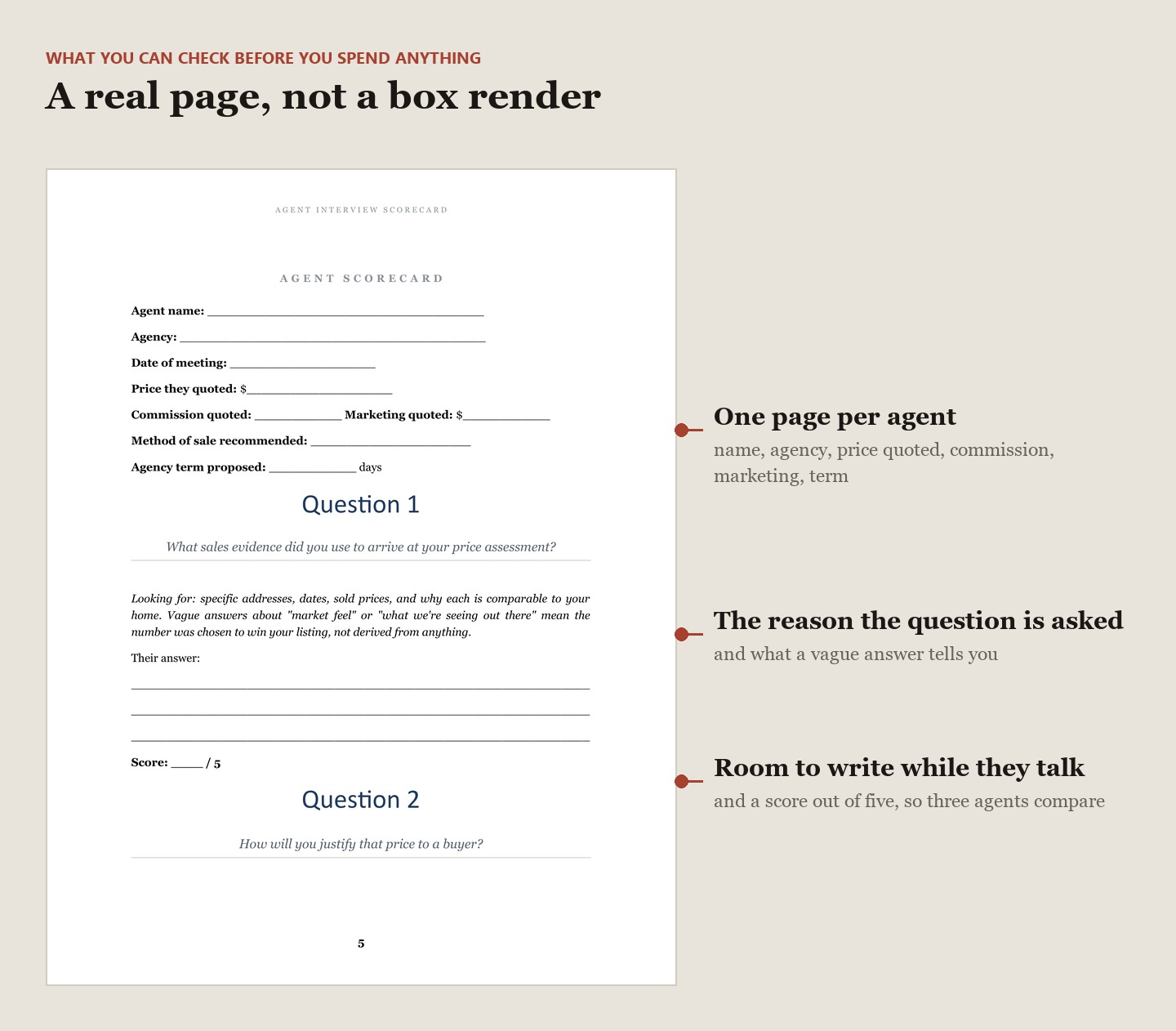
The Agent Interview Scorecard is one printed page. Seven questions, two pressure tests, and room to write the answers down while they are talking. It is free, there is no email form on it, and it is yours whether you ever buy anything from me or not.
Take it to the first appraisal. Ask the seven in the order they are printed in. Write down what comes back. Do it again at the second and the third, and three agents stop being three impressions and turn into a comparison you can read on one page.
It is not there to catch anyone out. It is there because a promise you write down in front of someone is a different kind of promise to one you nod at, and because the difference between a good answer and a rehearsed one is almost impossible to hold in your head and very easy to see side by side on paper.
Take the scorecard free → No email, no signup. Print one per agent.
I sold residential real estate at a small agency in Brisbane. I was involved in the sale of about eight houses. That is not a career. It is eighteen months of sitting in other people’s kitchens, and it was enough to hear the same conversation eight times and notice that it was a script.
I will be straight about why I left, because it should change how you read everything below. I did not leave in protest. I left because the job is brutal. Long hours, constant rejection, and people who had decided what I was before I finished a sentence. I was not cut out for it. I got out at twenty-one.
So I have no axe to grind and nothing to expose. I do not think agents are crooks. Most of the people I worked alongside were decent, and the job is harder than it looks from your side of the table. There is a kind of agent who genuinely works the buyer’s side, creates real competition and holds a position under pressure, and that person is worth every cent of a full commission. Part of what this is for is finding them.
Almost nothing that costs sellers money is villainy. It is structure.
Nothing in a standard commission arrangement rewards anyone for fighting hard on your behalf. And in all my time in the industry I never once met a seller who had been told that before they signed. Not because it was hidden. Because nobody’s job description includes explaining the structure to the person it works against, so it never gets explained, and everybody assumes somebody else covered it.
I wrote it down at twenty-one, in the months after I left, while I could still hear the conversations word for word. Then it sat in a folder for about a decade. When I finally went back through it, what unsettled me was how little needed changing.
These are not market conditions, which move constantly. They are incentives, and incentives sit still.
That is the whole credential, and I am not going to dress it up. The argument of this product is that experience asymmetry is what costs sellers money. I am not going to win your trust by pretending to have more of it than I do.
Every question in these books is free to ask before you sign an agency agreement. Every one of them is worth nothing the moment you have signed.
That is the mechanism, and it is the whole product.
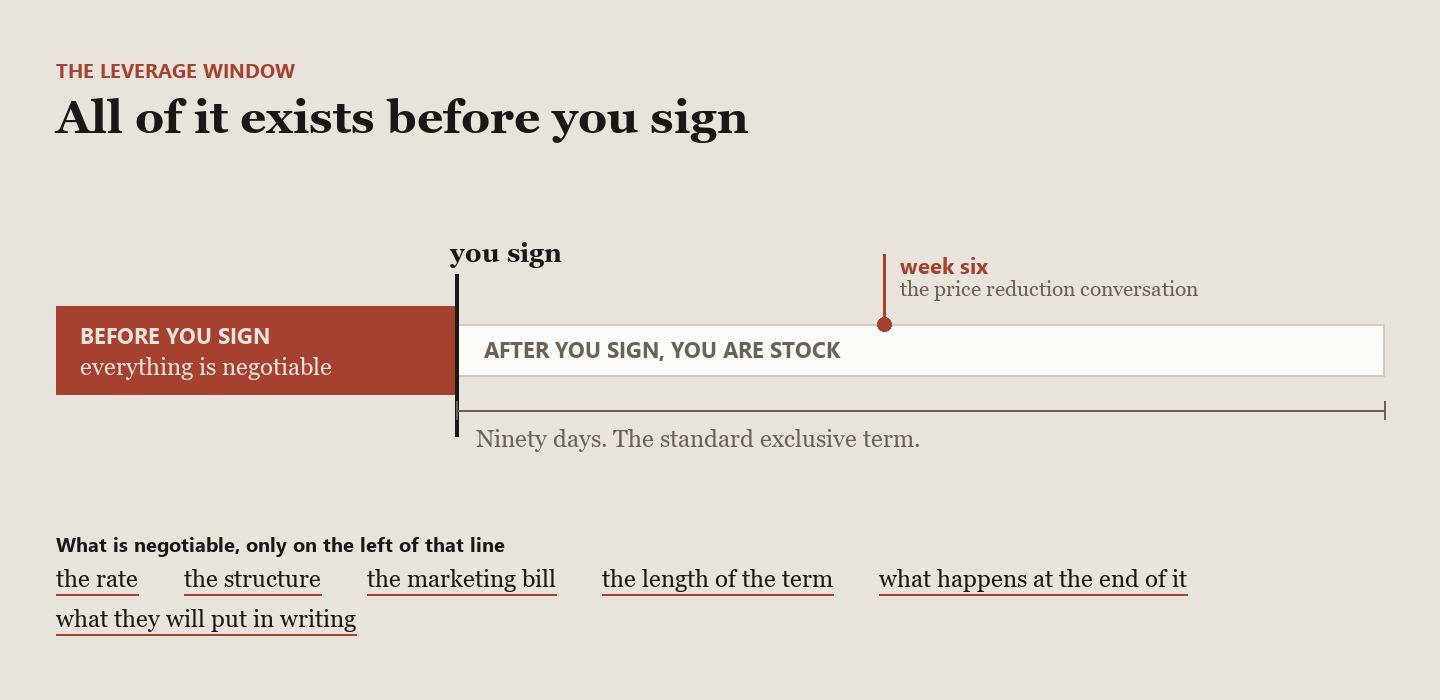
Ninety days is the standard exclusive term. Before you sign it you are somebody three agencies want to win, and everything is negotiable: the rate, the structure, the marketing bill, the length of the term, what happens at the end of it, and what they will put in writing. After you sign it, you are stock.
Here is what makes that expensive rather than merely annoying.
The window is at the beginning, and everything that goes wrong is at the end. Week six is when the price reduction conversation happens. Week six is when you find out whether the number that won them the listing was the number that sells the house. And by week six every piece of leverage you had is eleven weeks behind you, so the only lever left is the price.
None of that is a mistake. It is the ordinary arc of a campaign, running exactly as designed, experienced by the seller as a run of unfortunate market updates.
All of your leverage exists before you sign. Almost nobody uses it, because almost nobody is told it is there.
Most Australians believe it is.
In Western Australia there is no cooling-off period on a private sale. Not a shorter one. None. Consumer Protection WA is explicit about it, and the standard REIWA offer and acceptance form that most WA agents use does not contain one either.
In Tasmania there is none by statute. The standard contract carries an optional provision the buyer has to actively elect. If nobody ticks the box, there is not one.
In South Australia the clock does not start when you sign. It starts when you are served the Form 1, so a late Form 1 moves the deadline, and almost nobody records the date they were served.
In Queensland the agent is forbidden from giving you any price guide at all on an auction property, including the reserve.
And one rule that holds in all eight jurisdictions: there is no cooling-off period at any auction in Australia. Several states close the back door too. In New South Wales you lose it if you exchange on auction day after the property passes in. In Queensland if you were a registered bidder inside two business days. In Victoria for three clear business days either side.
The full eight-jurisdiction table is below, with the penalty, the waiver mechanism, the date it was checked and a link to each state’s own regulator.
Two offers arrive on a Saturday. You have until Monday.
| Offer A | Offer B | |
|---|---|---|
| Price | $805,000 | $790,000 |
| Conditions | subject to finance | unconditional |
| Settlement | 90 days | 30 days |
| Deposit | 5% | 10% |
| Buyer’s position | still has to sell their own home | already sold |
You are going to take Offer A, because $805,000 is more than $790,000 and every instinct you have says take the higher number.
Offer A is worth fifteen thousand more only if it settles. It is subject to finance, and it is subject to a stranger selling their own house inside ninety days. If it collapses in week four you have lost the six best weeks of your campaign, your listing carries a permanent public record of having been under offer and come back, and every buyer still watching has just learned to wait you out.
There are five columns on that table and price is one of them. Compare offers on all five or you are not comparing them.
Worked example. Illustrative figures, from chapter fourteen.
Your agent says the kitchen adds value. Almost certainly true. Here is the question almost nobody asks next.
How much does it add?
That is the second number, and the calculator exists to make you go and get it. Enter what the job costs. Enter what they say it adds. It divides one by the other against the 1.5× rule and returns do it or don’t, then works out what you would actually clear once commission, your time and holding costs are counted.
Forty thousand spent on a kitchen that adds forty-five thousand returns 1.13×. The verdict column says don’t. Move the added figure to sixty-five thousand and it flips.
Notice what that means about who is advising you. The upside on that extra spend, to the person recommending it, is a few hundred dollars. The downside to them is nothing at all. You are carrying the entire risk of the work not returning its cost.
The calculator does not tell you what a kitchen costs. It makes you ask for the figure that decides it.
Hypothetical figures. The spreadsheet you receive ships empty. You supply the numbers.
Cooling off is the clearest example. Every state handles it differently, two do not have it at all, and buyers routinely find that out on the day they sign. Every row below links to that state’s own regulator, with the date it was checked.
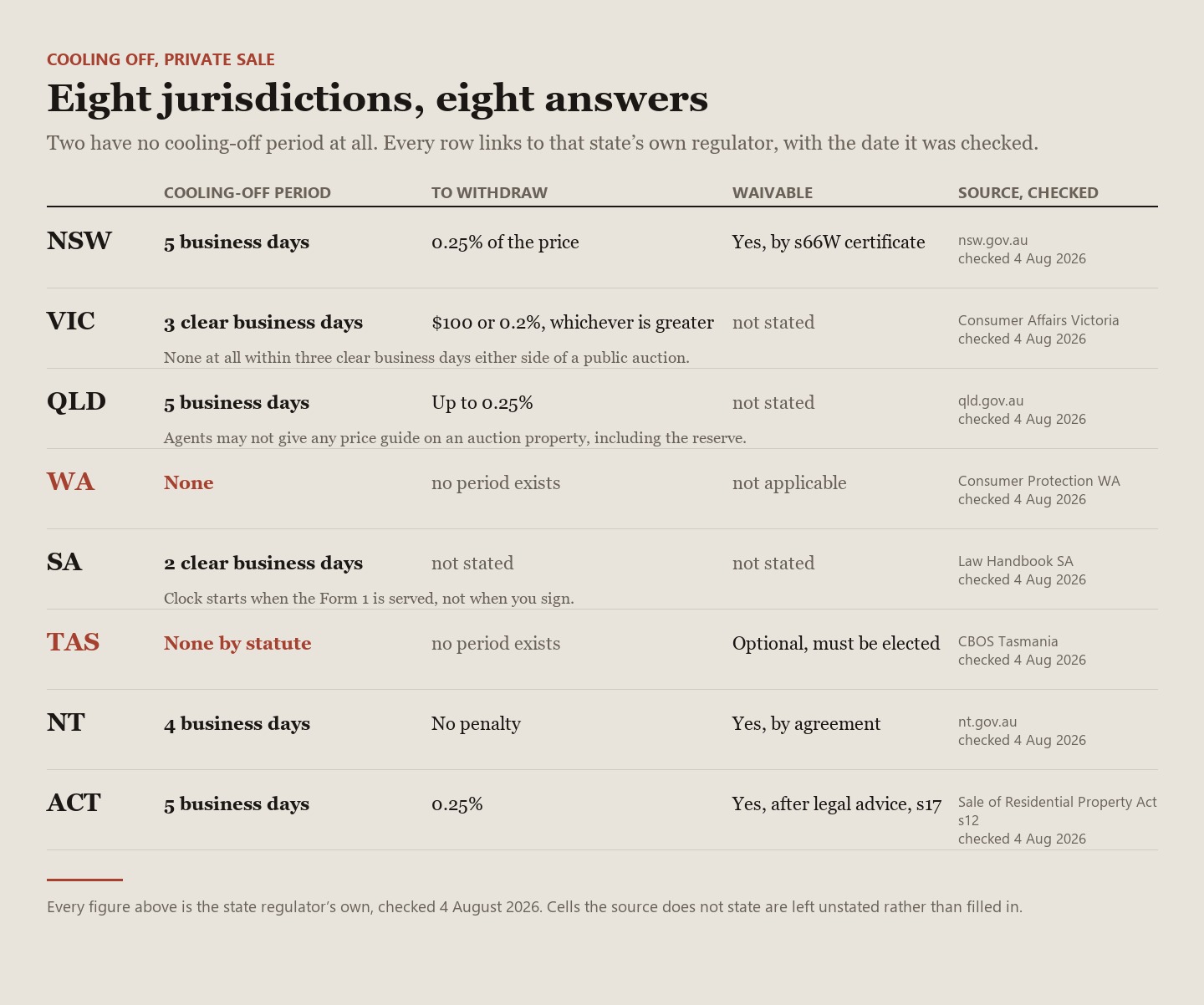
Cooling-off, private sale
Ends 5pm on the fifth. Withdraw and you forfeit 0.25% of the price. Waivable by a s66W certificate. And agents do ask.
nsw.gov.au · checked 4 Aug 2026
Penalty is $100 or 0.2%, whichever is greater. Nothing at all within three clear business days either side of a public auction.
Consumer Affairs Victoria · checked 4 Aug 2026
Up to 0.25% to withdraw. Agents here are also forbidden from giving you any price guide on an auction property, including the reserve.
qld.gov.au · checked 4 Aug 2026
Not a shorter one. None. Consumer Protection WA is explicit, and the standard REIWA contract most agents use does not contain one either.
Consumer Protection WA · checked 4 Aug 2026
The clock starts when you are served the Form 1, not when you sign. A late Form 1 moves the deadline, which almost nobody records.
Law Handbook SA · checked 4 Aug 2026
The standard contract carries an optional provision you have to actively elect. If nobody ticks the box, there is not one.
CBOS Tasmania · checked 4 Aug 2026
No penalty to withdraw. Can be waived, reduced or extended by agreement with the seller.
nt.gov.au · checked 4 Aug 2026
0.25% to withdraw. Can be shortened, but only after you have taken legal advice and your lawyer signs a s17 certificate.
Sale of Residential Property Act s12 · checked 4 Aug 2026
This is the level the books are written at. Strata, stamp duty, auctions, vendor-paid advertising, agency agreements. And the state you are actually standing in.
Current as at August 2026 and checked against each state’s own regulator on the dates shown. Rules move; check yours before you act on any of it.
On ProductReview, Australia’s two largest agency brands score 1.1 out of 5 and 1.0 out of 5 on transparency, against overall scores of 3.5 and 2.7. It is the lowest-scoring attribute of both, by a distance.
Their customers are not saying they are unskilled. They are saying they are impossible to see.
That does not prove this book is any good. It proves the thing this book is about is real, and that somebody other than me counted it.
What else you can check without paying me anything
If the free chapter and the free scorecard are not worth your time, nothing behind the paywall will be either. That is not a flourish. It is the actual test, and I would rather you ran it.
Look inside
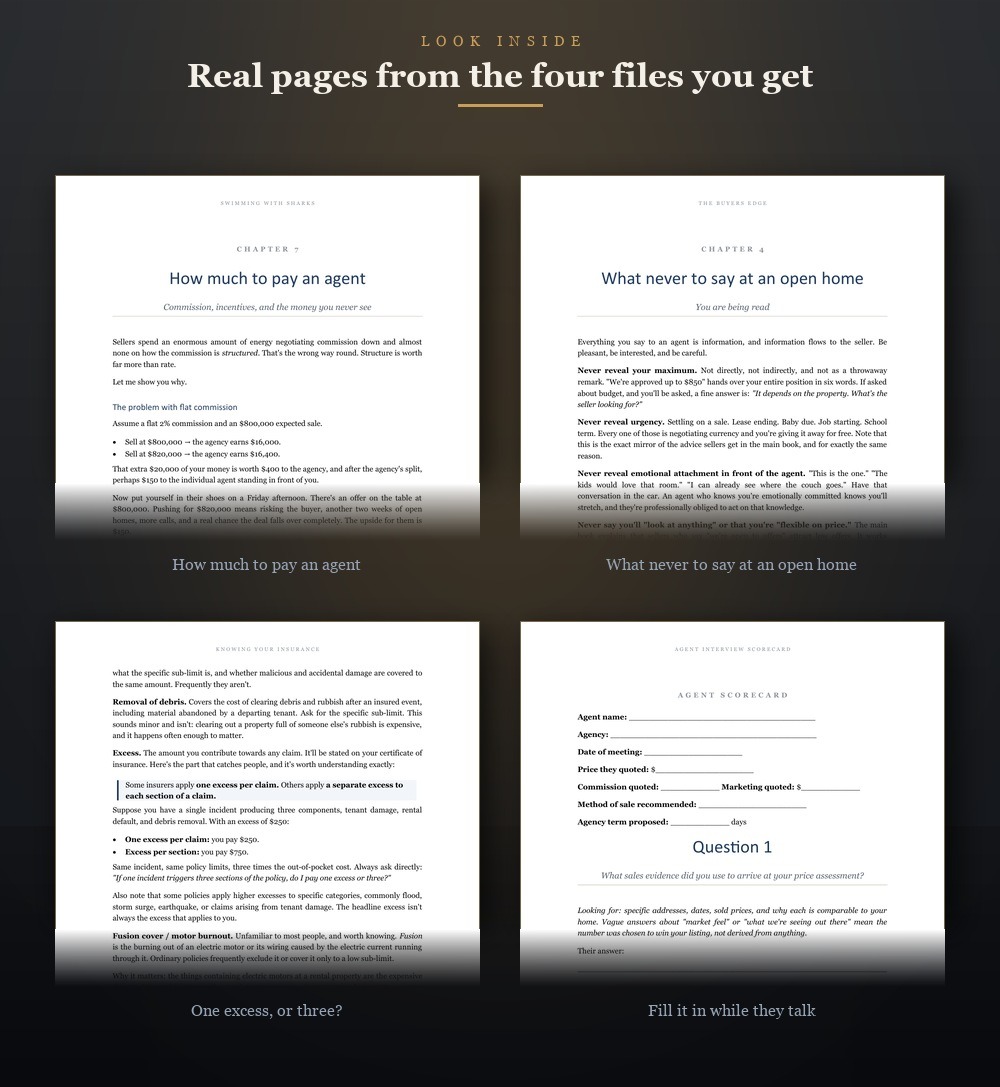
Top left to bottom right: the commission maths from Chapter 7, the open-home chapter from The Buyer’s Edge, the excess worked example from Knowing Your Insurance, and the scorecard you print and fill in.
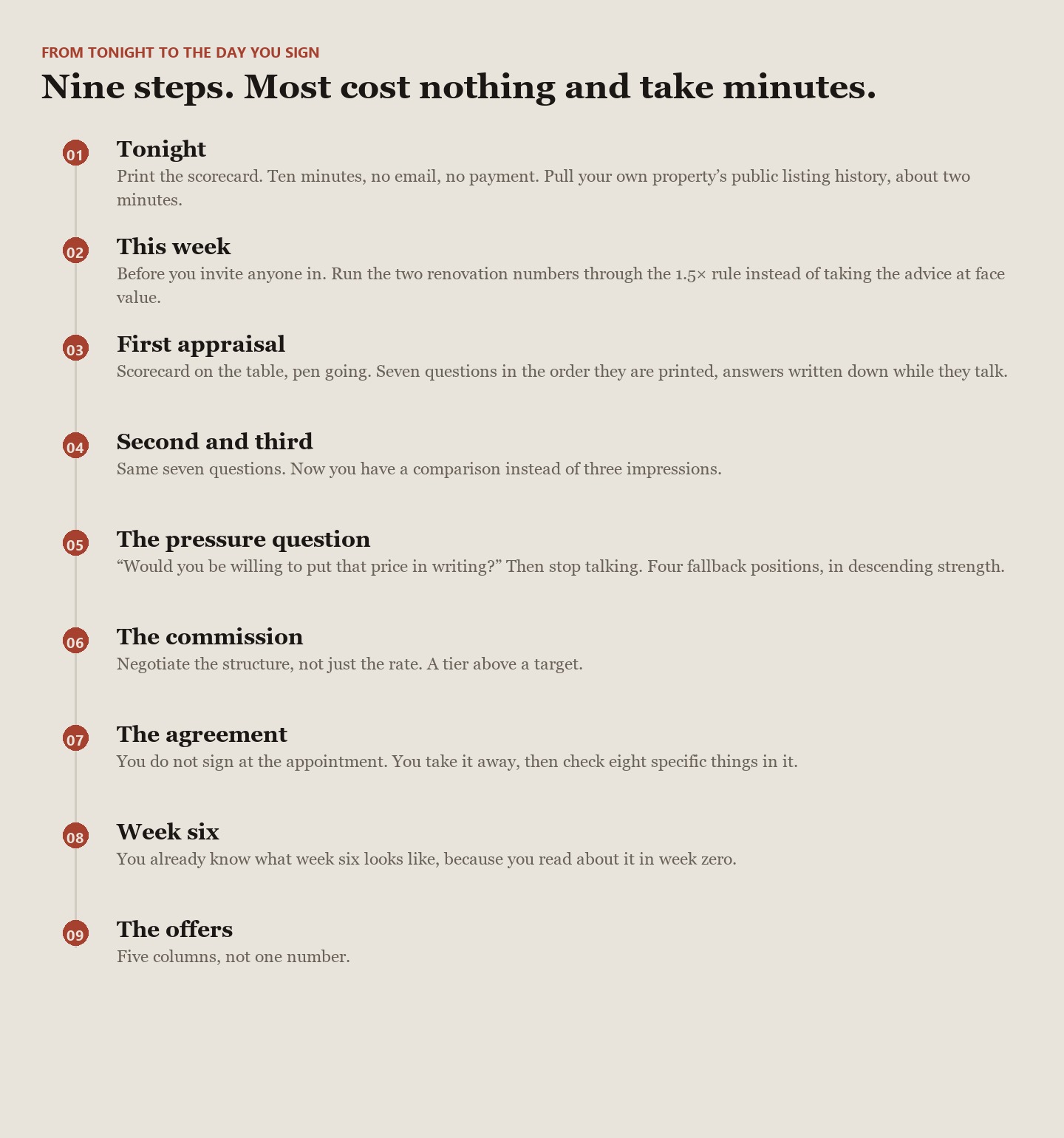
Tonight. You print the scorecard. Ten minutes, no email, no payment. You pull your own property’s public listing history, which takes about two minutes and which almost nobody does, and you find out what a buyer will see about it before they ever speak to you.
This week, before you invite anyone in. You get the two numbers on the renovation and run them through the 1.5× rule instead of taking the advice at face value. If it comes back under 1.0 you have already saved more than this costs, by not doing something.
The first appraisal. Scorecard on the table, pen going. You ask the seven questions in the order they are printed in, and you write the answers down while they are talking.
The second and third appraisals. Same seven questions. Now you have a comparison instead of three impressions, and the difference between a good answer and a rehearsed one is sitting on paper in front of you.
The pressure question. “That sounds great. Would you be willing to put that price in writing?” Then you stop talking. There are four fallback positions in descending order of strength, because most agents will not sign the strongest version, and you need to know that in advance or you will read a reasonable refusal as proof of bad faith.
The commission conversation. You negotiate the structure, not just the rate. A tier above a target is the only thing that fixes the hundred and fifty dollar problem instead of working around it.
The agreement. You do not sign it at the appointment. You take it away. There is no version of this where taking it away costs you the agent, and there are several where signing on the spot costs you thousands. Then you check eight specific things in it, including the clause that can leave you owing commission months after you have fired them, if the buyer was somebody they introduced.
Week six. You already know what week six looks like, because you read about it in week zero. So when the conversation starts you can tell the difference between real market feedback and the ordinary arc of a campaign.
When the offers come in. Five columns, not one number.
Nine steps. Most of them cost nothing and take minutes. The expensive part was never the work. It was not knowing the order.
Mostly you could find this. It is not hidden, it is not proprietary, and I am not going to pretend otherwise.
The problem is that you do not know what you do not know. You will not search “incentive commission structure” if nobody has told you that flat commission is a problem. You will not search “vendor paid advertising itemisation” until after you have paid for the package. You will not search “continuing entitlement clause” until you are changing agents and discover you still owe the last one.
What you are buying is not information. It is the assembly. Gathered, ordered, checked against each state’s own regulator, dated, and arranged in the sequence you are going to need it in, which is the sequence of the transaction rather than the sequence of a search engine.
Australian property paperbacks sit at about seventeen to twenty-seven dollars. This is forty-nine. So the fair question is what the difference buys.
The Australian bestseller list in this category is almost entirely investor books. Exactly one title in the top ten is written for a consumer selling their own home, and two of the ten are written for agents rather than for you. That is the shelf.
This is not on that shelf. It is three books for three sides of the same transaction, two tools you use in a room rather than read, and an eight-jurisdiction table checked against eight regulators. It is not a better version of the thing next to it. It is a different object.
This is a playbook, not a valuation. It will not tell you what your house is worth. It tells you what to ask, what to refuse, what to take away and read overnight, and where the money leaks.
Buy it if you want a process. Do not buy it if you want reassurance.
Do not buy it if you are a licensed agent looking for training. Do not buy it if you want get-rich-quick investing strategies. And do not buy it if you are outside Australia, because half of what makes it useful is that it is written for eight specific sets of rules, and none of them are yours.
Yours either way, before you spend anything
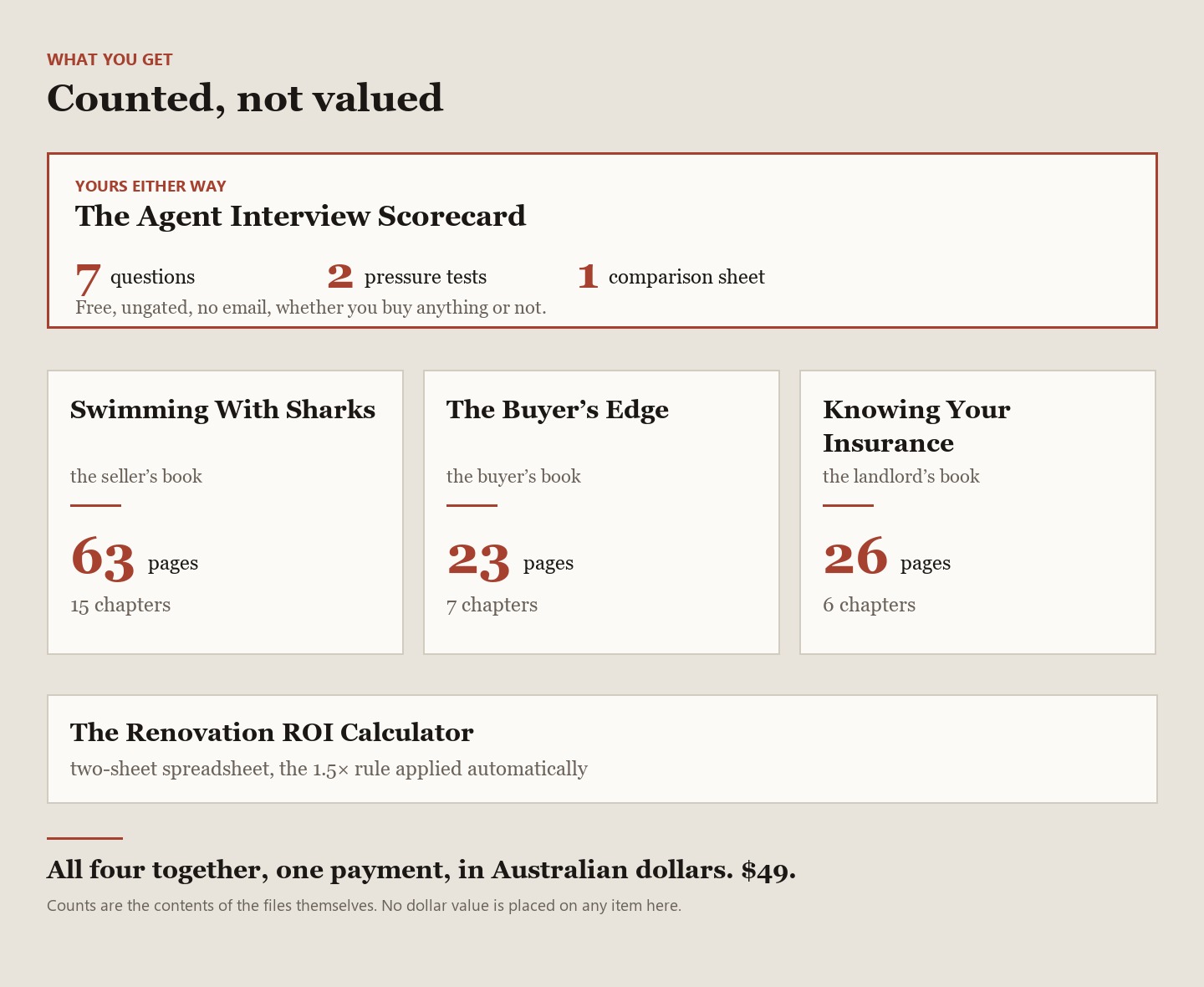
The Agent Interview Scorecard. Seven questions, two pressure tests, scoring, and a side-by-side comparison sheet so that three agents become a comparison instead of three impressions. Print one per agent. Free, ungated, no email, whether you buy anything or not. It is the part you need before you sign, so it is not behind the paywall.
What you are actually paying for
You are not choosing between forty-nine dollars and nothing. You are already committed to spending a great deal more than that on this transaction, and most of it is going to people whose interests are not identical to yours.
| What you are already spending | |
|---|---|
| The agent’s commission, at 2% on an 800,000 sale | 16,000 |
| The marketing package, paid up front, before any result exists | thousands |
| A buyer’s agent, if you hire one to do this side for you instead | 6,000 to 18,000 |
| A pre-sale renovation you were advised to do, on the advice of someone who does not carry the risk | tens of thousands |
| Six weeks stale on the market, then a public price reduction | the reason week six exists |
| Reading the other side’s playbook first, once | 49 |
Sixteen thousand dollars of that first line is not in dispute and is not illustrative. It is 2% of 800,000, and you will pay it whether or not you ever read a word of this.
So the real question is not whether forty-nine dollars is a lot of money. It is whether you spend one hundred minutes understanding a sixteen thousand dollar engagement before you sign it, or after.
That is also why it is forty-nine and not four hundred and ninety. Not because it is worth less. Because a four-hundred-dollar book does not get read by the person standing in a kitchen next Tuesday being told the market is very unpredictable at the moment. It gets bought, filed, and opened in week seven.
Illustrative figures based on an 800,000 dollar sale at a flat 2% rate. Commission rates, marketing packages and buyer’s agent fees vary by state, suburb and agency. Put your own numbers in.
Instant PDF. No app, no login, nothing to subscribe to, nothing that expires. The download link is on the confirmation screen and in your email. The calculator is an Excel file that also opens in Google Sheets and Numbers.
What that adds up to
Selling, buying and insuring what you own. Read in any order.
Short chapters, plain language, a points-to-remember box at the end of every one.
Every state and territory, with the penalty, the waiver mechanism and a link to the regulator.
The agent interview, scored, with the answers that should worry you.
The scorecard you print and the calculator you fill in. Both usable before you read a word.
Chapter one and the scorecard. Ungated, right now.
Sold by LanternPath, ABN 41 700 870 275, in Queensland, Australia. Payment is taken by Gumroad, by card, PayPal or Apple Pay. Your card details never reach me. If you would rather ask something before you buy than after, email hello@lanternpathbooks.com and I answer it myself. The full Terms of Sale and Privacy Policy are worth thirty seconds before you spend anything anywhere.
Chapter one and the whole scorecard are free and ask for nothing. They are the same voice and the same level of detail as the rest of it, so you can judge the writing before you spend anything.
Payment is handled by Gumroad, by card, PayPal or Apple Pay. Your card details never reach me.
Fair question, which is why it is on this page rather than hidden. A twenty-year veteran does not write this book. They cannot. They still have referral arrangements, relationships and a reputation inside a small industry. I had just left and had nothing to protect.
Then it sat in a folder for about a decade, and when I went back through it almost nothing needed changing. Judge it on the chapters that could only have been written from inside.
Book two is written for you. Book one is written for the person on the other side of the table, which is arguably more useful to you than your own book is, because it is the advice they are being given about you.
Start with the conditioning chapter and the one on comparing two offers that are not the same. Both are written for the seller. Both tell you what is being done across the table.
About one hundred minutes for all three, which is about 24,900 words at 250 words a minute. Short chapters, plain language, a points-to-remember box at the end of every one.
But you do not have to read it first. The scorecard works cold. Print it, take it to the first appraisal, and let the books explain afterwards why those seven questions are the seven.
Deliberately. Strata, stamp duty, auctions and passing in, vendor-paid advertising, agency agreements, cooling-off periods, and where the states differ.
Queensland prohibits any price guide at all on an auction property, including the reserve. Western Australia has no cooling-off period on a private sale. Advice written for one state is worse than useless in another. All eight jurisdictions are in section 07 above.
PDF, downloadable immediately, readable on a phone, a tablet, a laptop or printed. The calculator is an Excel file that also opens in Google Sheets and Numbers. Nothing to install and nothing to cancel.
No. General information based on my time in the industry. Property law differs by state and changes over time. Get advice from a licensed professional for your own situation.
The deadline is real anyway, and it is yours, not mine.
Every question in these books is free to ask before you sign an agency agreement, and worth nothing the moment you have. Ninety days is the standard term. Most sellers find out what they gave up in week six.
You get one clean run at the first thirty days on the market. There is no version of this where you go back and do it again knowing what you know afterwards.
Or read chapter one free, and take the scorecard free, and decide afterwards. Neither one asks for your email.
Read chapter one free → Take the scorecard free →
Do not be afraid of the sharks. Just do not get in the water without knowing they are there.
One email most weeks on what is actually happening in Australian property: what moved, what the rule changes mean, and the things agents say to each other but not to you. Free, and separate from the books.
One email most weeks. No phone number, because I am not asking for one. Nobody calls you. No agent, no partner and no third party ever receives your address. Unsubscribe in one click. Privacy Policy.